Showing posts with label eBooks. Show all posts

Tuesday, July 6, 2010

Why eBooks are better than Whitepapers

eBooks and whitepapers are two formats for sharing longer written documents on the web. While both of these terms are often used interchangeably, they are actually two different types of documents. 

eBooks tend to be shorter and more interactive than whitepapers. eBooks often include links to additional multimedia information and focus on the how-to aspect of a subject. Whitepapers are more static and less interactive than eBooks and focus more on thought-leadership content.

What Makes eBooks So Good?

  • They’re simple to create and inexpensive to produce – You don’t need a publisher or a printer! You just need some basic software and the time to write about your idea or innovative technique.
  • They’re engaging – Because they aren’t just PDFs or Word docs, you can actually get your reader to interact and take some type of action. Encourage them to click on links, fill out a survey, subscribe to your blog, watch a video or even buy something from you online.
  • They’re easy to distribute and spread like wildfire – Make the ebook free (don’t collect money, don’t collect email addresses) and add a Creative Commons license to the content so people can share the e-book easily. Create a landing page, add a call-to-action on your website, blog about it, put a link your email signature, email it to your friends/partners/vendors, post a video on YouTube, tell your fans and followers. 
  • They’re easy to read and more eco-friendly – Although whitepapers can be read online, the vertical formatting makes them difficult to read. eBooks are easily to read digitally on-demand while whitepapers often need to be printed to be read easily.

What Makes Whitepapers So Bad?

  • They’re boring - Wikipedia defines a whitepaper as “an authoritative report or guide that often addresses issues and how to solve them. White papers are used to educate readers and help people make decisions.” Even the definition puts me to sleep.
  • They’re old school - They date back to the early 1900s. You might remember The Churchill White Paper of 1922 from your high school history class, you might not. Either way, we haven’t really changed the way we use them since then. They’re still a form of semi self-promotion and propaganda. It’s just that now they are found on the web and are used by businesses as a marketing or sales tool rather than promoting government policy.
  • They’re forced upon us – Most people don’t want to read whitepapers, they just feel like they have to read them because they’re “authoritative” and written by “industry leaders”. Or because their boss said so.
  • They’re not good link bait – Because you typically have to register (give your email address) to download the whitepaper, most people don’t promote or share whitepapers because they don’t want to force their fans and followers and friends to give their email address away and get hounded by sales reps.
I don’t hate whitepapers. I mean, whitepapers are still useful. But, eBooks are a better way to share on-depth content online. So start writing and sharing your eBook. You’ll be surprised at how fast your ideas will spread and your business will grow.

The most important concepts to remember, whether you choose to create an eBook or a whitepaper, are to have fun with it, write for your audience and be sure you’re actually providing valuable information and awesome ideas.

By Emily Haahr

Monday, June 14, 2010

eBook Piracy "Surges" after iPad Launch


This blog was written by Ernesto on TorrenFreak. Here is the original address: http://torrentfreak.com/ebook-piracy-surges-after-ipad-launch-100409/ 

Here is the blog: 

With 500.000 iPads sold in the first week, Apple’s new multi-gadget is already a force to be reckoned with. As book publishers see the iPad as a potential threat to their revenues, we take a look to find out what happened to eBook piracy in the last week. The results are surprising.

The introduction of Apple’s iPod marked a significant change in the music industry’s business. When it was first released in 2001 there were no digital music stores online. By the end of that decade the number of digital music sales had outgrown physical sales by far. 

This year the book industry may see the definite breakthrough for eBooks, and again an Apple device is expected to play a facilitating role. Having watched the changes in the music industry where piracy is often portrayed as a huge threat, some book publishers already fear the worst.
The million dollar question is whether or not these fears are justified. How big of a threat is eBook piracy for the book industry? Is there a noticeable iPad effect? We have some interesting numbers to share.

To determine if Apple’s iPad has had en affect on eBook piracy we looked at the number of downloaded titles before and after its introduction. We decided to focus our research on the 10 best selling eBooks on Amazon which seemed to be a good starting point. The problem, however, is that none of these books are available on public BitTorrent, nor could we find them on file-hosting services or Usenet.

This in itself is quite an interesting observation, and clearly a signal that eBook piracy is not (yet) as widespread as that of music and movies. In order to come up with some comparison material we decided to change our sample to the 10 best selling paperback books in the business category, which should also fit well with the demographics of iPad buyers.

From this list 6 of the 10 books were available on BitTorrent. Although we have to note that BitTorrent may not be the only source of eBook piracy, it should give us a good indication of the iPad effect, if there is any. To do so, we tracked the download numbers from Saturday till Thursday, a week before the iPad launch and the days after. 

By comparing the data from these two samples we found that the number of unauthorized eBook downloads on BitTorrent grew by 78% on average, a significant increase. It is worth noting that all of the six eBooks had more downloads after the iPad launch than before.

David Allen’s productivity guide ‘Getting Things Done’ was by far the most downloaded eBook with an average of 435 downloads a day, up from 277 before the introduction of the iPad. However, this 57% increase is relatively small compared to some of the other titles we tracked.
‘Freakonomics’, another classic in the business section, saw a 104% increase in downloads, going from 187 to 381. ‘How We Decide’ saw an even bigger surge in downloads – 140% – as downloads went from 56 to 134. 

The three remaining books from the list that we tracked on BitTorrent are ‘The Tipping Point’, ‘How Women Decide’ and ‘The 7 Habits Of Highly Effective People’. These three titles all saw an increase in downloads, 21%, 47% and 71% respectively, with absolute download numbers after the iPad launch of 192, 52 and 82. 

Interesting data, but what can we conclude from the statistics?
First of all, there seems to be a significant iPad effect if we assume that the increase in downloads is in part related to the iPad introduction. On the other hand it is clear that the absolute download numbers are relatively small compared to those of music and films, where popular releases can have more than a million downloads in one week. 

This low piracy figure can in part be explained by the fact that the number of people with an iPad or other eBook reader is still relatively low. Another key factor is that most books are simply not available in a pirated version, so buying a book through an online store is far more convenient and faster than trying to find an unauthorized copy.

The convenience factor and the overall user experience are going to be the key advantages for the book industry. When the iPod was launched there were no digital download stores, making file-sharing networks the only option to get music easily.

As a final note we have to stress that piracy does not equal lost sales. In the academic publications that looked into the link between piracy and (music) sales, there is still no consensus on this topic. For now, the book industry is best off putting all their efforts into making a great product for consumers and we’re sure that the iPad can be of assistance there. 

In the months to come we will keep en eye on how eBook piracy evolves.


Tuesday, April 27, 2010

Wednesday, April 21, 2010

Can a new publisher flourish?


Here is a blog piece I came upon yesterday evening. This blog piece comes from the Guardian Newspaper on the 14th of July 2009. The piece written by Sam Jordison is titled "Can a new publisher flourish?" With most publishers battling one another on price and new digital formats, can a new publisher thrive in this jungle? We must also not forget the issue of digital rights management (DRM) when it comes to eBooks. Publishers not ready for these issues will not last long in the market place. Not to mention an unwillingness by customers to pay the same price for an eBook as a print book.

Anyway, here is the piece as promised and by the way, comments anyone?

Last weekend, I drove down the Suffolk coast to Aldeburgh to witness the launch of an increasingly rare phenomenon: the first book of a new publishing house. This new venture is Full Circle Editions, set up by Bloomsbury co-founder and Harry Potter discoverer-in-chief Liz Calder, together with TV producers John and Genevieve Christie and a former editor of the Bookseller, Louis Baum.


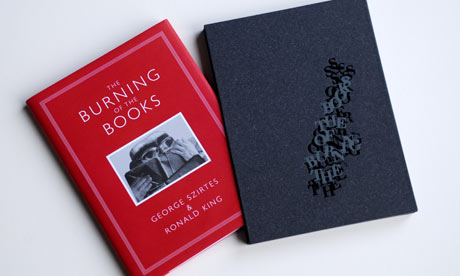
The book – called The Burning Of The Books – is also a collaborative effort; between the poet George Szirtes and the artist Ronald King. It's printed on creamy tactile paper, complete with luxurious fold-outs. Genevieve Christie sells it as "wonderful writing in a lovely form" and the prints spread out about the room certainly looked good. The Guernica-influenced pictures, etched in white and black (heavy on the black) have a dark kind of beauty. I wasn't really in a position to judge the poem – a busy room full of noisy, bread-stick munching paragons of the chattering class is no place to form an opinion about such an involved work – but it did have a certain sombre weight and words that would – at the least – be worth more detailed study.

But I was there out of curiosity about the new publishing house as much as the physical product. There's an inherent interest in all these big names getting together – especially now, when publishing is so mired in difficulties: when small presses such as the much-loved Dedalus are lurching from crisis to crisis, bigger houses are announcing job losses every other week and cynical marketers are attempting to stifle the variety and independence of publishing outlets yet further by locking us into dependence on purchasing hubs such as the Kindle – a device with fire-based säuberung embedded in its name and repression in its DRM-infected software.

Setting up a new publishing house in the teeth of recession seems therefore almost like an act of rebellion – especially when the house in question is dedicated to the promotion of the value of books as objects, and whose first release is – significantly – a reworking of Elias Canetti's book-destruction nightmare, Auto Da Fé.

Certainly Liz Calder sounded defiant when I was introduced to her. Full Circle Editions, she said, is emphatically not "profit oriented, market driven or celebrity ridden." Meanwhile, she and her fellow directors want to "produce beautiful books without marketing people telling you that you can't do it." It sounded to me like she was releasing some of the vexations built up at the head of what became one of the biggest commercial publishing operations on planet earth, and she agreed that she was realising a "frustrated ambition".

If you were to look at it cynically, you could describe this publishing operation as something of an indulgence. You might also get that impression from the party's location in sleepy, prosperous, comfortable Aldeburgh: Bloomsbury-on-sea, but without the museums. And it would be all too easy to form a prejudice about the appearance of the crowd gathered for the launch: a dignified selection of prosperous white-haired men with shirts tucked into neatly pressed trousers, and elegant women in the not-too-flowery flowing dresses favoured by the ageing intelligentsia. Finally, the limited print run and marketing of the books has a taint of hobbyism about it too. But I'd prefer not to be cynical for once. Who, after all, would forbid someone like Liz Calder an indulgence – especially if the net result is an attractive, intellectually provocative book that maintains a sharp edge and dark heart in spite of its cosy origins?

So I found myself warming to the event, even if it did give me a sudden, bleak vision of the possible future of book publishing: one rather like the past we're supposed to have escaped, in which worthwhile paper books are the exclusive play-thing of a well-to-do elite, and, in the place of the church, DRM-wielding gate-keepers control access for the rest of us.

Then again, if the cartoonist Glen Baxter (one of several of Liz Calder's successful protégés who put in an appearance) is to be believed, this launch wasn't entirely unlike the beginning of Bloomsbury – which also began in elitist fashion in the middle of a recession. And we all know how that ended. Perhaps there is some cause for hope here. The irresistible pun will come true and things will come full circle. "This is Liz Calder, " Glen Baxter said. "And she'll just keep going and going. She won't stop … "

Thursday, April 15, 2010

Audio Page Update

People,

You may remember that our previous audio page had just a selection of non-fiction books as well as a link to a selection of fiction books. We want to inform you that you can now view all your MP3 books in all their categories. You also have access to the sub-categories. We would like to offer our apologies for any inconvenience. Thank you, and get reading, get creating, and get cracking.

Wednesday, April 14, 2010

Yes, It is Official - We Are Open For Business

This is to let all know that we are now officially open for business. Nosadigital sells fiction and non-fiction for both book formats. Nosadigital also deals in eBook readers as well as MP3 players, and iPods.


At Nosadigital, we give you all you need to either create or enjoy your e and audio books. Electronic books are becoming increasingly popular. Why not try one and see if you will not love them. Audio books go one-step further. Are you one of those people who would rather have someone read you the book than actually read it? If so then audio books are for you. Whether you are in your car or the bathroom it really does not matter. You can enjoy it all the same. 


Nevertheless, let us suppose you are one of the creative types. Moreover, you would rather create a book than read one. Nosadigital is the place for you as we have everything you need to create that book. From digital recording equipment to the software required, we have it all. Over time, we will even advise you through our blog on ways to accomplish all the necessary tasks of achieving your objectives. Besides, if you do not like any particular product, you can always return it. So there, what are you waiting for? Get reading, get creating, and get cracking.